
Bluefish on the Outer Banks: Why They're One of Summer's Best Surf Targets
Posted by Heather James on 20th Jul 2026
Bluefish on the Outer Banks: Why They're One of Summer's Best Surf Targets
Ask anyone who fishes Hatteras Island in the summer what their favorite surf species is, and bluefish will come up fast. They hit hard. They run hard. They show up in big schools that turn a quiet stretch of beach into chaos in about ten seconds. And when you cook one fresh that night, you remember exactly why locals love them.
If you're new to OBX fishing or just want a clearer picture of how to target blues this summer, this guide walks through when they show up, what gear works, and how to put yourself in front of them.
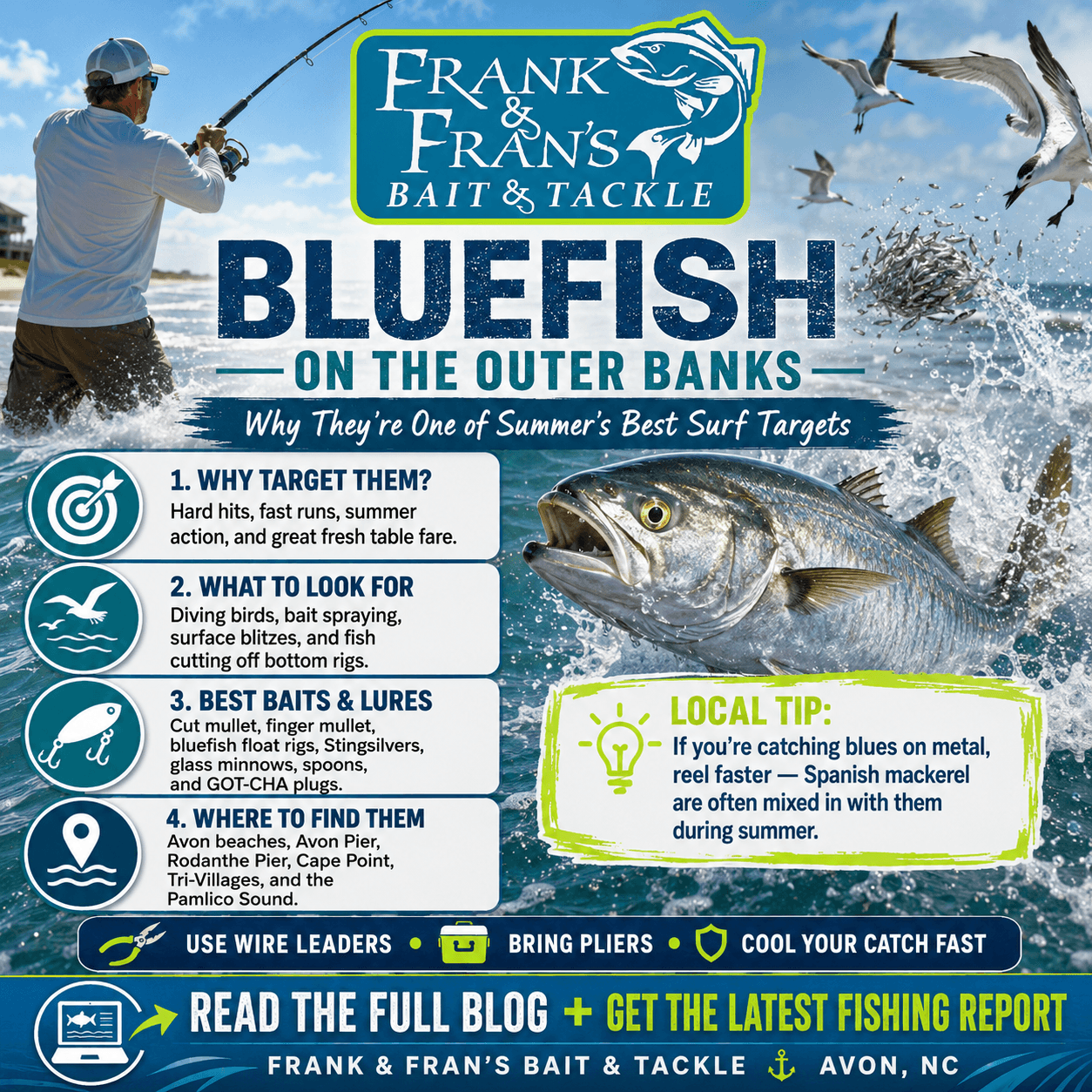
Why Bluefish Are a Top Summer Target
Bluefish are aggressive, fast, toothy predators that travel in schools and feed on baitfish. When a school finds a bait ball just off the beach, the action is unmistakable. Splashes everywhere. Bait getting flipped out of the water. Birds diving on the leftovers. It's one of the most exciting things you can see from the sand.
A few reasons they're so popular with Hatteras Island anglers:
- They fight hard, hit aggressively, and pull drag
- They show up in numbers, so multiple anglers in a group can catch fish
- They're accessible from the beach without long walks or specialty setups
- They eat well when handled and cooled properly right after the catch
- They keep the action going all summer when other species slow down
The downside? Sharp teeth. Always use wire leaders, long-nose pliers, and a hook remover. Bluefish do not care about your fingers.
When Bluefish Show Up on Hatteras Island
Bluefish are a temperature-driven species. They prefer water in the upper 60s to low 70s, around 66 to 72 degrees. On the Outer Banks, that means the strongest runs usually hit in spring and fall, but summer schools still push through, especially smaller "snapper blues" and mid-sized fish that hold around bait pods near the beach and the piers.
What to watch for in summer:
- Diving birds working a tight spot just past the breakers
- Bait spraying or jumping out of the water
- Other anglers walking fast in one direction
- A sudden change in your bottom rig getting bitten off
The bigger chopper blues (fish in the 10+ pound class) tend to show in spring and fall around drum runs. Summer is more about consistent action on smaller and mid-sized fish, with the occasional surprise giant.
For the latest on what's running, check the daily Frank & Fran's fishing report before you head out.
Rods and Reels for Bluefish
You don't need specialty bluefish gear. A standard medium-heavy surf setup handles them well. The two scenarios that matter:
For bait fishing the wash and the slough, a 9' to 11' surf rod paired with a 4000 to 6000 size spinning reel covers most situations. Browse the full surf rod selection for options across price points.
For casting metal at busting fish, you want something a bit lighter and faster. A 9' rod rated 1 to 4 ounces lets you fire long casts and work lures aggressively. The Ninja Tackle Dagger 9' K-Series was built for exactly this kind of fishing. Active casting, metals and plugs, and the kinds of bluefish, Spanish mackerel, and slot drum runs you walk the beach to find.
Pair either setup with a saltwater-rated spinning reel and rinse it down after every trip. Bluefish blood is hard on tackle.
Rigs for Bluefish
This is where matching the right rig to the conditions makes a real difference.
Float Rigs and Fireball Rigs
When bluefish are around but not blitzing on the surface, a float rig suspends a piece of cut bait in the water column where blues are cruising. The float keeps the bait off the bottom, the wire leader protects against the teeth, and the color of the float draws attention.
The Sea Striker Bluefish Float Rig is built on 60 lb black nylon-coated Sealon wire with a 2" fluorescent oval float and a 7/0 plated hook. It's the original Hatteras bluefish rig, and it still produces.
Chotty's Bluefish Rig is another local favorite. Heavy-duty components, ready to fish, designed to stand up to repeated hits without losing tackle.
Mullet Rigs for Bigger Blues
When the chopper blues are around and you want to fish a larger bait, a mullet rig with a wire leader is the move. The Kraken Toad Finger Mullet Rig, which is a Frank & Fran’s exclusive rig featuring a float and bucktail is the way to go.
For more options, the full surf fishing rig selection at Frank & Fran's covers shark, drum, pompano, bluefish, speckled trout, and flounder.
Bait That Works for Bluefish
Bluefish are opportunistic, but they have favorites:
- Cut mullet is the all-around best. Fresh or frozen, on a float rig or a mullet rig, mullet catches blues consistently.
- Frozen finger mullet is convenient and effective. Frank & Fran's stocks frozen mullet year-round.
- Menhaden (bunker) is excellent when you can get it fresh.
- Squid and shrimp work when blues are feeding on smaller prey, especially with smaller hooks for snapper blues.
Match the bait size to the size of fish you're seeing. Small chunks for the snapper blues that swarm summer beaches. Larger sections of cut mullet when bigger fish push through.
Lures for Casting at Busting Bluefish
When you see a school feeding on the surface, switch to metal and start covering water. Blues key on flash and speed.
- Stingsilvers and Glass Minnows by Shore Lure and ES Lures are the go to on the OBX.
- Hopkins Hammered Spoon. The classic OBX casting spoon. Casts a mile, sinks fast, and the hammered finish flashes like a wounded baitfish.
- Acme Kastmaster Spoon. Compact, heavy for its size, and dialed in for fast retrieves through a feeding school.
- GOT-CHA Plug. A darting plug that works well from the piers and the beach when blues are in tight to the breakers.
- Tsunami Zig Jig Pro. A fast-sinking metal that handles wind and chop, useful when the surf is up.
For the full assortment, the artificial bait and lure selection is the place to browse.
A small strip of mullet on the back hook of a lure leaves a scent trail and can pick up a few extra fish when the bite gets picky.
**LOCAL TIP** If you are catching blues on metal, reel faster and there are typically spanish mackerel mixed in with the blues in the summer.
Tactics That Catch More Bluefish
Cast long, retrieve fast. Blues are reaction strikers. A slow lure is a lure they swim past. Keep it moving.
Read the birds. Diving terns and gulls give you the location of a feeding school before you can see the fish. If you see birds working, get there.
Walk the beach. Schools travel. The angler who moves with them catches more than the one anchored to a single set of sand spikes.
Cool your catch fast. Bluefish meat softens quickly in heat. Bleed the fish at the gill, drop it into a cooler with plenty of ice, and you'll have great table fare that night.
Wire leaders, always. Even snapper blues will sever a fluorocarbon leader in one bite. Wire is non-negotiable.
Watch your fingers and feet. Sharp teeth, slippery decks, and excited anglers are a bad combination. Use pliers, control the fish, and keep kids back when you're handling one on the sand.
Where to Find Bluefish on Hatteras Island
Bluefish run the entire island, but a few spots stand out.
Avon Pier and Rodanthe Pier
Both piers see strong bluefish action through summer. The deeper water at the end of each pier holds fish, and the structure pulls bait in. Plugs and metal jigs work from the planks. So do float rigs with cut mullet.
Avon Beaches
Easy access, consistent action, and you're right down the road from the shop if you need to swap a rig or grab fresh bait.
Cape Point
When the bait runs heavy, Cape Point can produce some of the biggest blues of the season. Currents converge here, bait stacks up, and blues follow.
Tri-Villages (Rodanthe, Waves, Salvo)
Strong summer beaches for snapper blues and mid-sized fish, with easy ramps and good walking beaches.
A solid beach cart makes a real difference when you're chasing a moving school down the beach with rods, a cooler, and a rig bag.
Pamlico Sound
The bluefish bite can be good sound side in the summer. Ramps 53 and 54 just north of Frank & Fran’s are great ramps to give it a shot. We especially like to use cut mullet on a drum slider rig or double drop bottom rig at dusk for a shot at blue and drum. **LOCAL TIP ** Your best shot it to wade out into about waist deep water and then cast out. There is an old navigation channel that runs parallel to shore where fish will hold.
Blues for Dinner
Bluefish is best when eaten fresh not frozen. If you land a blue, be sure and bleed it by cutting it just behind the gills. Be sure and keep it whole until you leave the beach, per local regulations. Ginger, who worked at the shop for many years said the best way to cook a blue fish is to filet it, slather it with mayonnaise and top it with sliced onions and throw it on the grill. Locals also like to make fish cakes out of bluefish.
Stop In Before You Head Out
Frank & Fran's has been outfitting Hatteras Island anglers since 1988, and summer bluefish are one of the most-asked-about species in the shop. The staff fishes these waters every day. They know which beaches the blues are hitting, what rigs and metals are producing, and which baits are fresh that morning.
Stop by the shop in Avon for fresh and frozen bait, the right wire-leader rigs, a couple of go-to casting spoons, and a quick rundown of where the bite was that morning. Or browse surf fishing tackle online to stock up before your trip.
Bluefish bring summer surf fishing to life on the Outer Banks. Find a school, throw something shiny, and hang on. See you on the sand.